
Relief Valve Testing in the Field: Common Challenges That Impact Accuracy


Why is pressure relief valve testing less accurate in the field?
Field pressure relief valve testing (PRV / PSV testing) is less accurate because uncontrolled conditions—such as limited clearance, unstable mounting, and inconsistent load application—affect how force is applied and measured.
The most common causes include:
- Restricted access and poor alignment
- Improper or uneven load application
- Unstable or improvised mounting setups
- Technician variability
- Environmental factors during in situ (in-line) pressure relief valve testing
These conditions lead to:
- Inaccurate set pressure readings
- Non-repeatable test results
- Increased compliance and safety risk
Following procedure alone does not guarantee accuracy in field pressure relief valve testing.
What Is Pressure Relief Valve Testing?
Pressure relief valve testing (also called PSV testing, safety valve testing, or pressure safety valve testing) is the process of verifying that a valve:
- Opens at its specified set pressure
- Achieves proper lift behavior
- Reseats within acceptable limits
Pressure relief valve testing confirms:
- Set pressure accuracy (calibration)
- Opening response (pop or proportional behavior)
- Seat integrity (leak performance)
These are not separate tests—they are different aspects of the same pressure relief valve testing process.
Testing is required to meet standards such as:
- ASME (American Society of Mechanical Engineers)
- API (American Petroleum Institute)
- National Board (NBBI)
Pressure relief valve testing can be performed:
- On a test bench (controlled environment)
- In the field using in situ (in-line) testing
In-Line vs. Bench Pressure Relief Valve Testing
Understanding the difference between in-line and bench pressure relief valve testing helps determine the right method based on accuracy requirements, system downtime, and operational constraints.
| Testing Method | Description | When Used |
| In-line (in situ) pressure relief valve testing | Valve remains installed in system | When minimizing downtime is critical |
| Bench pressure relief valve testing | Valve removed and tested in controlled environment | Calibration, rebuilds, inspections |
In-line pressure relief valve testing improves efficiency, but bench testing provides higher accuracy due to controlled conditions.
Why Accuracy in Pressure Relief Valve Testing Matters
A pressure relief valve is a safety device.
If pressure relief valve testing is inaccurate:
- The valve may not open at the correct pressure
- The system may not be protected
- Overpressure events can lead to equipment damage or failure
For service providers, inaccurate pressure relief valve testing creates:
- Liability exposure
- Compliance risk
- Safety concerns
A valve that has been tested incorrectly cannot be trusted to perform when required.
Why Field Pressure Relief Valve Testing Introduces Accuracy Problems
Field testing—especially in situ pressure relief valve testing—introduces variability that does not exist in a shop environment.
Controlled shop conditions:
- Proper alignment
- Stable mounting
- Repeatable setup
- Controlled load application
Field conditions:
- Limited space
- Inconsistent setups
- Environmental variability
- Manual force application methods
These directly affect:
- How load is applied
- How measurements are taken
- How repeatable the test is
Even when procedures are followed, field conditions can compromise pressure relief valve testing accuracy.
Common Causes of Inaccurate Pressure Relief Valve Testing Results
1. Restricted Clearance
Cause: Limited access around the valve
Common in:
- Tight piping systems
- Skid-mounted equipment
- Congested process areas
Impact:
- Poor alignment
- Increased risk of side loading
Result: Inaccurate set pressure readings
2. Improper or Uncontrolled Load Application
Cause: Manual force application (hand jacks and similar methods) introduces variability
In many field setups, technicians apply force using:
- Hand jacks
- Manual pumps
- Non-controlled mechanical loading
Impact:
- Uneven or jerky force application
- Difficulty maintaining a consistent load rate
- Inconsistent approach to the valve’s set pressure
Result:
- Inaccurate set pressure readings (calibration errors)
- Poor repeatability between tests
- Increased technician-dependent variation
Why This Matters: Pressure relief valve testing depends on smooth, controlled force application as the valve approaches its set pressure.
Manual methods make it difficult to apply force consistently—especially near the simmer point.
3. Improvised Mounting Setups
Cause: Lack of stable, purpose-built mounting
Impact:
- Movement during testing
- Inconsistent positioning
Result: Invalid or misleading test data
4. Technician Variability
Cause: Differences in experience and technique
Impact:
- Inconsistent setup
- Variation in execution and interpretation
Result: Different results for the same valve
5. Environmental and Jobsite Conditions
Cause: Vibration, temperature, workspace limitations
Impact:
- Equipment instability
- Measurement variability
Result: Reduced accuracy outside technician control
Field Testing Challenges vs. Impact on Accuracy
The table below summarizes how common field challenges affect the accuracy of relief valve testing.
| Challenge | What Happens | Impact on Testing |
| Restricted clearance | Poor alignment | False set pressure readings |
| Improper load application | Uneven or inconsistent force | Inaccurate and non-repeatable results |
| Improvised mounting | Movement during testing | Invalid data |
| Technician variability | Different methods | Non-repeatable tests |
| Environmental conditions | Instability | Measurement error |
Addressing these challenges requires more than procedural compliance—it requires controlled, purpose-built testing systems.
Why Smooth, Controlled Force Application Matters
Accurate pressure relief valve testing depends on how force is applied—not just how much force is applied.
As the valve approaches its set pressure:
- Small variations in force can change the measured result
- Sudden or uneven loading can distort lift behavior
- Inconsistent force application reduces repeatability
Manual systems (such as hand jacks) inherently introduce:
- Operator-dependent variability
- Non-linear or jerky force application
- Difficulty controlling the rate of load
Motor-driven systems provide:
- Smooth, continuous force application
- Controlled, linear loading toward set pressure
- Repeatable, operator-independent results
This is especially important during:
- In situ pressure relief valve testing
- Testing near the valve’s simmer point
- Applications requiring high repeatability
The Hidden Risk: Passing Results That Are Wrong
A valve can pass pressure relief valve testing—and still be unsafe.
If test conditions are compromised:
- Measured set pressure (calibration) may be incorrect
- Leak performance may not reflect actual operation
- Results may not be repeatable
This creates:
- False confidence
- Increased failure risk
- Compliance exposure
A “passing” result is only valid if the test conditions are controlled and repeatable.
Why Repeatability Matters in Pressure Relief Valve Testing
Accuracy alone is not enough.
Pressure relief valve testing must also be repeatable.
A valid test produces:
- Consistent results
- Under consistent conditions
- Across different technicians
Without repeatability:
- Results cannot be verified
- Documentation cannot be defended
- Calibration cannot be trusted
Repeatability is what makes pressure relief valve testing reliable.
How Modern Field Testing Improves Accuracy
Modern field testing systems improve accuracy by controlling the variables that matter most:
- Motor-driven load application (eliminates manual variability)
- Stable, purpose-built mounting
- Consistent alignment
This improves:
- Set pressure accuracy (calibration)
- Repeatability across technicians
- Reliability of pressure relief valve testing results
By reducing variability, field testing becomes more dependable.
Low-Profile Testing for Clearance-Restricted Valves
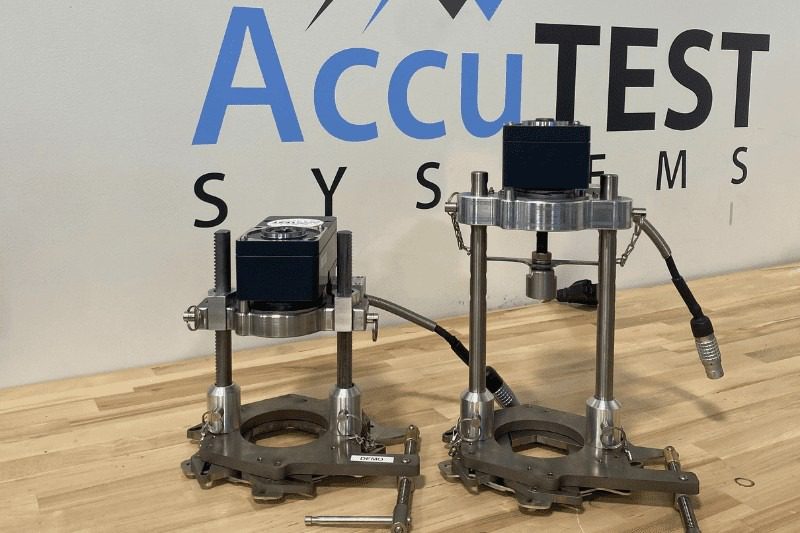
In clearance-restricted environments, standard equipment cannot be positioned correctly—especially during in-line (in situ) pressure relief valve testing.
Low-profile systems are designed to:
- Operate in tight spaces
- Maintain proper alignment
- Support stable mounting
This enables:
- Controlled, smooth force application
- Reliable calibration results
- Consistent pressure relief valve testing
Accuracy Is Not Just Equipment — It’s Execution
Pressure relief valve testing accuracy depends on:
- Equipment
- Setup
- Operator
Field challenges are both:
- Mechanical
- Operational
Improving accuracy requires:
- Proper training
- Standardized procedures
- Reliable field support
Accuracy is determined by the system, setup, and execution.
Checklist: How to Improve Field Testing Accuracy
✓ Use equipment designed for in situ pressure relief valve testing
✓ Avoid improvised mounting setups
✓ Ensure proper alignment before applying load
✓ Use systems that provide smooth, controlled (motor-driven) force application
✓ Standardize testing procedures
✓ Reduce operator variability through training
✓ Prioritize repeatability over speed
FAQ: Pressure Relief Valve Testing in the Field
Why is pressure relief valve testing less accurate in the field?
Field testing introduces variability such as poor alignment, unstable mounting, and inconsistent force application, which reduces accuracy and repeatability.
What is in situ pressure relief valve testing?
In situ pressure relief valve testing is performed while the valve remains installed in the system.
What is PSV testing?
PSV testing stands for pressure safety valve testing, another term for pressure relief valve testing.
Why does manual force application reduce accuracy?
Manual methods like hand jacks introduce uneven and inconsistent loading, making it difficult to accurately measure set pressure.
Is calibration part of pressure relief valve testing?
Yes. Calibration (set pressure verification), leak performance, and valve behavior are all part of the same testing process.
Is in-line testing less accurate than bench testing?
It can be, due to field variability. However, controlled systems can significantly improve in-line testing accuracy.
Accuracy in Pressure Relief Valve Testing Is Not Assumed — It’s Engineered
Pressure relief valve testing accuracy is not determined by procedure alone.
Field conditions introduce variables that directly affect results—from restricted clearance and unstable setups to inconsistent load application and operator variability.
Without controlled setup and repeatable testing:
- Results cannot be trusted
- Systems may not be protected
A passing result only has value if the conditions behind it are reliable.
Accuracy is not assumed.
It is verified.
Find the right setup for your workflow.
Talk to an AccuTEST specialist about improving field testing accuracy.


