
Why Smooth Force Application Matters More Than Automation in Safety Valve Testing

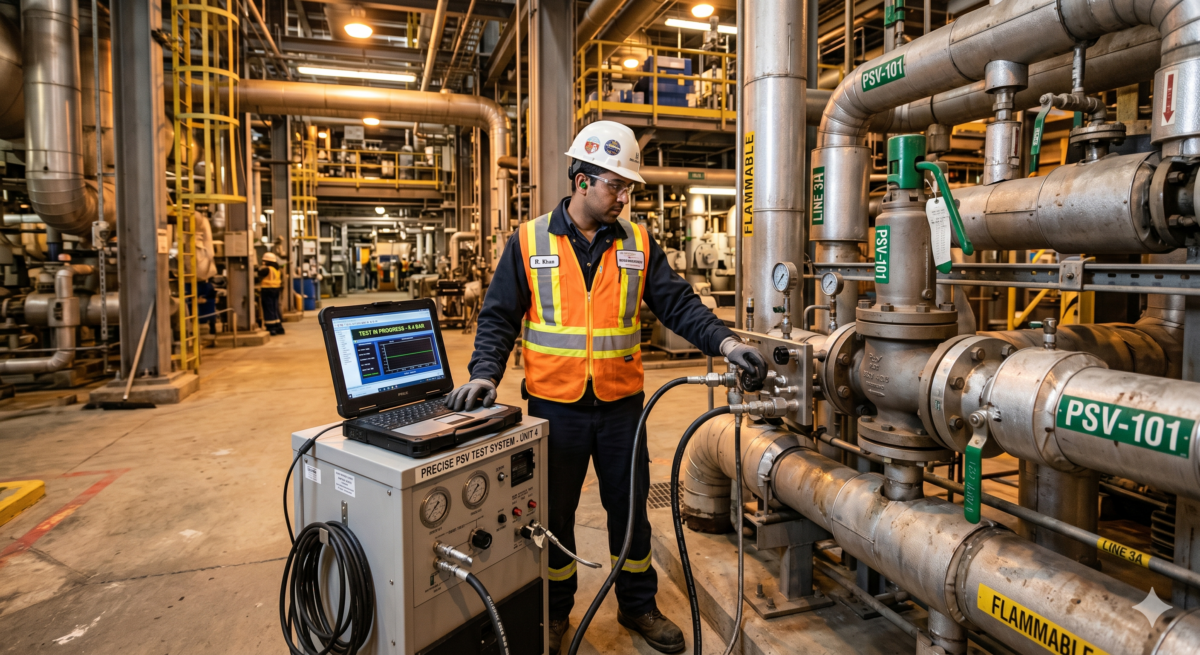
The best in-line test systems don’t replace the technician—they give them better control.
| Quick Answer: Smooth, controlled force application—not automation itself—is what makes safety valve testing more accurate and repeatable. Hydraulic hand jacks introduce variability because force depends on how the operator pumps the handle. The AccuTEST System replaces manual pumping with precise electronic force application, in both Manual Mode and fully automated sequences, so the technician stays in control while the test becomes smoother and more consistent. |
Every experienced valve technician knows that approaching set pressure is the most critical part of a safety valve test.
The goal isn’t simply to apply force. It’s to apply it smoothly, predictably, and under complete control.
Traditional hydraulic hand jacks have been the industry standard for years, but they introduce one unavoidable variable: the force depends on how the operator pumps the handle.
The AccuTEST System takes a different approach. It gives technicians the same level of control they’re accustomed to while replacing manual pumping with precise electronic force application. Whether operating in Manual Mode or using a fully automated test sequence, the technician remains in control of the test—not the equipment.
Key Takeaways:
- The biggest hidden variable in PSV testing isn’t the sensor or the software. It’s how force is applied as the valve approaches set pressure.
- Hydraulic hand jacks create small pressure surges that vary by operator, by shift, and even test-to-test with the same technician.
- The AccuTEST System doesn’t remove the technician from the test. It removes the variability caused by manual pumping.
- Manual Mode and fully automated sequences are both available; automation is an option, not a requirement.
- Smoother force application reduces retesting, improves data consistency, and strengthens compliance documentation.
What’s the Hidden Variable in Manual Valve Testing?
Most discussions about test accuracy focus on load cells, sensors, calibration, or software.
But one of the largest variables is much simpler.
It’s how force is applied.
Hydraulic hand jacks naturally produce incremental pressure increases as the technician pumps the handle. Those small surges become increasingly important as the valve approaches its lift point.
Even highly experienced technicians cannot produce exactly the same force profile every time. The result can be subtle differences between operators, between shifts, and even between repeated tests by the same technician.
Does Automation Mean Losing Control of the Test?
One misconception about automated testing systems is that they remove the technician from the process.
That’s not how the AccuTEST System works.
In Manual Mode, the technician controls exactly how the load is applied. The difference is that the electronic actuator replaces the hydraulic hand pump.
Instead of creating force through repeated pumping, the technician commands a smooth, continuous increase in load.
The operator still decides:
- When to begin the test
- How quickly to approach the set pressure
- When to pause or continue
- How to interpret valve behavior
The only thing removed is the variability created by manual pumping.
When Does Full Automation Make Sense?
Some facilities prefer standardized testing procedures across multiple technicians and locations.
For those situations, the AccuTEST System can execute a fully automated force ramp.
- Every test follows the same programmed load profile.
- This provides exceptional repeatability while reducing technician workload.
- The important point is that automation is an option—not a requirement.
- Technicians can choose the method that best fits the application.
| Manual Hand Jack vs. AccuTEST System: At a Glance | |||
|---|---|---|---|
| Testing Method: | How Force Is Applied: | Technician Control: | Best Fit For: |
| Traditional Hydraulic Hand Jack | Manual pumping; force depends on operator technique | Full control, but with natural pumping variability | Single-technician sites without standardized procedures across locations |
| AccuTEST System – Manual Mode | Electronic actuator; technician commands a smooth, continuous load | Full control over pace, pauses, and interpretation | Technicians who want familiar hands-on control with smoother execution |
| AccuTEST System – Automated Sequence | Programmed force ramp follows a set load profile | The technician oversees the test; the profile is standardized | Multi-technician, multi-location facilities needing repeatable procedures |
How Does Better Force Control Improve Test Data?
Smooth, repeatable force application offers several practical benefits.
It helps reduce:
- abrupt load spikes near the simmer point
- operator-to-operator variation
- fatigue during repetitive testing
- unnecessary retesting caused by inconsistent force application
When testing programs support maintenance decisions, compliance documentation, and valve performance trending, greater consistency improves confidence in the results.
When testing programs support maintenance decisions, compliance documentation, and valve performance trending, greater consistency improves confidence in the results. This lines up with API Recommended Practice 576, the industry standard for inspecting pressure-relieving devices, which emphasizes documented, repeatable inspection and testing practices as part of a sound reliability program.
The AccuTEST System: Designed for Technicians, Not Instead of Them
Experienced technicians understand valve behavior in ways that software cannot.
The AccuTEST System was never intended to replace that experience.
Instead, it removes one source of unnecessary variability while preserving the technician’s ability to observe, interpret, and control the test.
The result is a testing process that combines skilled human judgment with smoother, more repeatable force application.
Better Control Is the Real Upgrade
The future of safety valve testing isn’t about replacing technicians with automation.
It’s about giving technicians better tools.
Whether operating in Manual Mode or using a fully automated test sequence, the AccuTEST System allows technicians to remain in control while delivering smoother force application, more consistent results, and digitally documented test records.
Because better control—not simply more automation—is what leads to better testing.
See the AccuTEST System in Action
If your team is still relying on hydraulic hand jacks and absorbing the variability that comes with them, it’s worth seeing what smoother, technician-controlled force application looks like in the field.
Visit AccuTEST Systems to explore the full lineup, including the AccuTEST-SL, AccuTEST-TT, and Low-Profile Load Rig, or talk to our team about the Trade-In Program to see how an upgrade fits your outage season schedule.
Frequently Asked Questions
What’s the difference between manual and automated safety valve testing?
Manual testing uses a hydraulic hand jack, where force depends on how the technician pumps the handle. Automated testing uses an electronic actuator to apply a programmed, repeatable force ramp. The AccuTEST System supports both modes, so technicians can choose the approach that fits the job.
Does using the AccuTEST System replace the need for a skilled technician?
No.
The technician still decides when to start the test, how quickly to approach set pressure, and how to interpret valve behavior. The AccuTEST System removes the variability of manual pumping—it doesn’t remove the technician’s judgment from the process.
What causes inconsistent results in hydraulic hand jack valve testing?
Hand jacks produce force in small pumping surges rather than a smooth ramp. Even experienced technicians can’t reproduce the exact same force profile every time, which creates variation between tests, shifts, and operators.
Can technicians choose between manual and automated test modes on the AccuTEST System?
Yes. Manual Mode gives the technician full control over the pace and timing of the load, replacing the hand pump with a smooth electronic actuator. A fully automated sequence is available for facilities that want a standardized, programmed load profile across multiple technicians or sites.
Why does smooth force application matter for PSV testing accuracy?
Sudden load spikes near the simmer point can distort test results and lead to unnecessary retesting. Smooth, controlled force application reduces operator-to-operator variation and produces more consistent, trustworthy data for compliance and maintenance decisions.
When does full automation make sense for valve testing?
Full automation is a good fit for facilities running standardized procedures across multiple technicians or locations, since every test follows the same programmed load profile. It’s optional, not required—technicians can still run tests manually when that’s the better fit.
How does consistent force application support valve testing documentation?
More consistent test results improve confidence in maintenance decisions, compliance records, and valve performance trending over time, since the data reflects true valve behavior rather than variation introduced by the testing method.


