
Your Last Outage Exposed the Gaps: Modernizing Field Valve Testing Before Fall

Spring outages don’t just get the maintenance work done. They act as a high-stakes, real-world stress test for your entire valve testing program.
The operational bottlenecks on the floor, including unreliable set pressure readings, painfully long setup times, and severe operator fatigue, are the direct byproduct of outdated equipment that is holding back your field technicians.
As modern industrial operations face tighter shutdown schedules and smaller maintenance crews, the window between spring and fall is the optimal time to transition from reactive troubleshooting to proactive optimization.
| Quick Answer: When Should You Upgrade Pressure Relief Valve Testing Equipment?If your last outage revealed issues such as inconsistent results, difficult setups, slow testing, technician strain, or excessive downtime, it may be time to upgrade your pressure relief valve testing equipment. Modern automated systems help improve repeatability, reduce operator variability, simplify testing, and support faster outage execution. |
The Mechanical Bottlenecks of Legacy Manual Test Rigs
Traditional field setups utilizing mechanical or hydraulic handjacks are fundamentally incapable of delivering the repeatability required by today’s regulatory standards.
Manual pumping inherently introduces an uneven, jerky application of force that fluctuates based on individual operator technique. This lack of linear force application makes identifying the exact simmer point heavily subjective, compromising set pressure verification and introducing steep liability risks.
Because a hand jack cannot apply force smoothly and continuously, the exact moment a valve begins to lift is subjective, making accurate, repeatable set-pressure verification difficult.
Beyond accuracy loss, manual test rigs saddle service providers and plant operators with severe physical logistical liabilities. Cumbersome external hydraulic fluid lines add excessive weight, require heavy dual-technician carries, and introduce mess and leak risks straight into process environments.
When a test crew is forced to struggle through complex rigging and unstable, improvised positioning just to establish an isolated checklist line item, your entire outage timeline is compromised.
Engineered Precision: Automation and Self-Aligning Rig Architecture
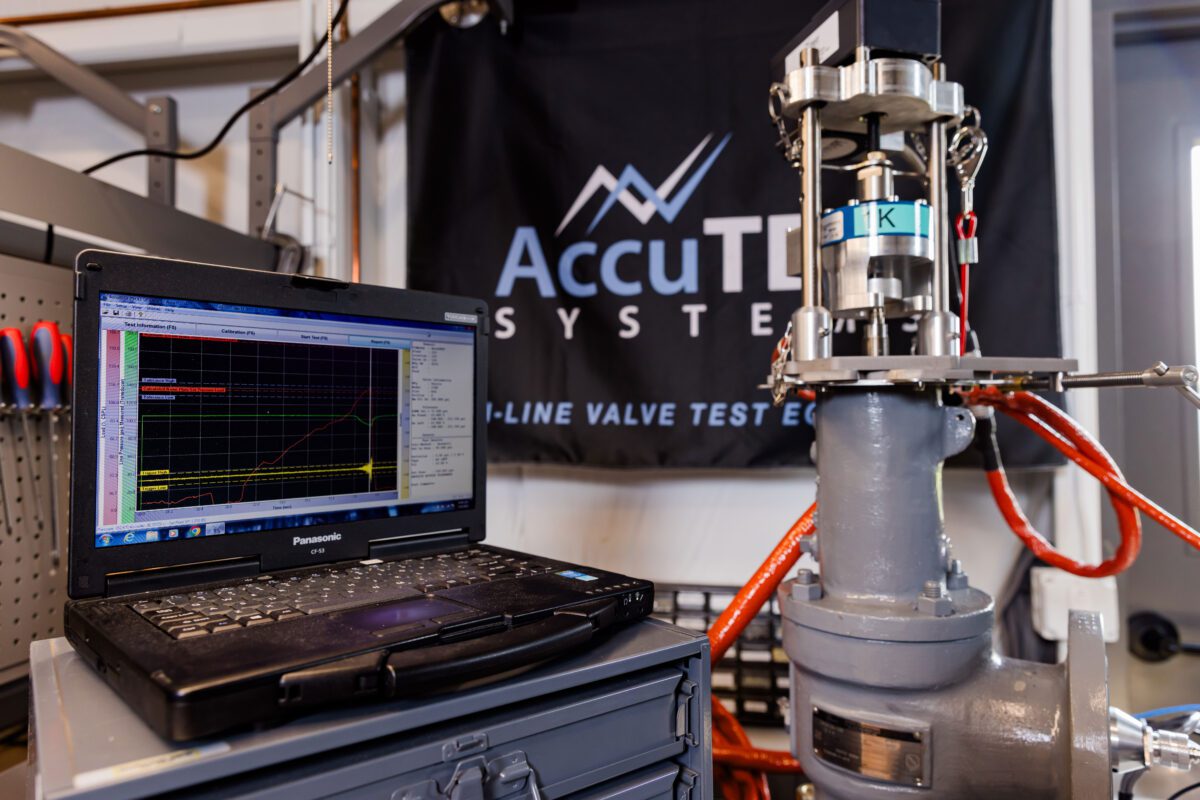
The AccuTEST System completely standardizes field execution by replacing inconsistent human loading with a fully automated, computer-controlled electric motor actuator.
By applying perfectly smooth, linear force directly toward the setpoint, the system completely removes operator-to-operator variability.
Always remember that accurate, repeatable safety relief valve testing depends entirely on your physical setup. One of the most critical engineering advantages of the AccuTEST platform is its purpose-built, self-aligning rig architecture.
Traditional systems are exceptionally vulnerable to side-loading forces, which can skew test metrics or alter internal mechanical tolerances. AccuTEST’s self-aligning system ensures the applied pull remains perfectly square to the valve stem axis.
This mechanical guardrail completely eliminates side-loading risks, ensuring the valve seats and reseats flawlessly while protecting critical internal components under live operating conditions.
Legacy Field Methods vs. Automated Execution:
Traditional field valve testing platforms are structurally limited by the mechanical compromises of manual design.
When field technicians must rely on unaligned configurations or manual force, the entire calibration process becomes subjective, introducing unnecessary risk into the facility path.
Upgrading to an engineered electronic architecture removes operator-dependent variability entirely.
| Performance Vector | Legacy Handjack & Hydraulic Rigs | The AccuTEST System |
| Force Application & Repeatability | Relies on manual handjacks and mechanical pumping, which inherently introduce an uneven, jerky application of force that fluctuates based on individual technician style, making pinning the exact simmer point highly subjective. | Utilizes a computer-controlled electric motor actuator to deliver perfectly smooth, linear force directly toward the setpoint, eliminating human variability test after test. |
| Structural Alignment | Exceptionally vulnerable to severe valve stem side-loading forces, which can easily distort live test metrics, alter delicate internal tolerances, or damage internal valve components during lift cycles. | Engineered with a purpose-built, self-aligning rig architecture that ensures the applied pull remains perfectly square to the valve stem axis, completely neutralizing side-loading risks. |
| Process Safety & Fluid Logistics | Saddled with cumbersome external hydraulic fluid lines that add dead weight, restrict workspace movement, and introduce chronic leaks and safety hazards directly into sensitive process environments. | Features a fluidless, fully electric execution system that removes the risk of fluid spills, environmental contamination, and subsequent cleanup liabilities on the floor. |
| Labor Efficiency & Portability | Requires heavy dual-technician carries and complex rigging procedures to position the unaligned, bulky components around clearance-restricted valves. | Built with lightweight, portable structural components and smart clamping mechanisms explicitly optimized for safe, rapid, single-operator setup and field execution. |
| Traceability & Data Capture | Dependent on subjective manual data logging and retroactively compiled paperwork, which slows down reporting cycles and creates defensibility gaps during compliance audits. | Driven by advanced software that dynamically captures pressure and lift data in real time, instantly outputting secure, unalterable digital calibration records. |
Operational Impact on Outage Timelines
When a service firm or maintenance crew utilizes manual pumping methods, they are choosing to manage process variability through technician interpretation rather than calibrated physical control.
By shifting from legacy hydraulics to a standardized electronic setup, plant operators secure clear operational advantages. Technicians no longer struggle through long setup loops or face physical strain from maneuvering heavy, fluid-filled systems across tight process skids.
The self-aligning mechanics ensure that the safety valve seats and reseats flawlessly under live conditions without altering internal component tolerances—minimizing downtime and providing total confidence in audit readiness before the facility pushes back to full operational capacity.
Don’t Carry the Same Problems Into Your Next Outage
By pairing computerized automation with lightweight structural portability, manufacturing executives and service leaders can systematically eliminate field inefficiencies:
- One-Technician Operation: The system features lightweight, portable components and smart clamping mechanisms that allow a single operator to handle setup and execution independently—safely scaling down crew sizes during labor shortages.
- Defensible, Audit-Ready Reports: Industry-leading software automatically captures pressure and lift data dynamically, outputting instant digital calibration certificates that remove the risk of manual data-logging errors.
- Downtime Compression: Seamless in-line testing verification directly on operating valves completely eliminates the time-consuming labor loops of valve removal, transport, and benchmarking.
Proactive Fleet Optimization With AccuTEST’s Trade-In Program
It is important to address underlying operational vulnerabilities while recent performance records and field data are completely fresh. Modernizing your fleet between outage cycles removes the immense logistical pressure of active shutdowns, allowing you to train personnel on your own schedule.
The AccuTEST Systems Trade-In Program is strategically structured to lower capital cost barriers to modernization. We evaluate your current physical inventory and provide direct credit toward an automated system—regardless of whether you are trading in older AccuTEST models, heavy hydraulic setups, or competitor manual gear.
Frequently Asked Questions
How does automated valve testing compare to standard mechanical lifting methods?
Standard mechanical lifting methods, such as legacy handjacks, rely heavily on operator technique, leading to erratic force application, safety issues with hydraulic fluid lines, and severe valve stem side-loading risks.
Automated testing replaces manual pumping with a computer-controlled electric motor actuator and a self-aligning rig architecture, delivering continuous, linear force that completely neutralizes human variability and protects internal valve component tolerances.
Why are companies replacing manual hydraulic test rigs?
Many companies are replacing older hydraulic systems because they can create inconsistent results, increase technician strain, require more setup time, and rely heavily on manual processes.
What types of equipment qualify for AccuTEST’s trade-in program?
Eligible trade-ins may include:
- Older AccuTEST systems
- Hydraulic or manual test rigs
- Competitor valve testing equipment
Ready To Improve Your Valve Testing Process?
Your last outage likely revealed where your testing operation is losing time, consistency, or efficiency.
AccuTEST helps valve service companies and facilities modernize pressure relief valve testing with automated, field-ready systems designed for repeatable results, one-tech operation, and reduced downtime.
Whether you’re upgrading an older system or moving away from manual testing, now is the ideal time to evaluate your options before fall outages begin.
Talk to an AccuTEST expert about trade-in opportunities and modern valve testing solutions. how AccuTEST systems improve pressure relief valve testing →


