
What Size Load Cell Should I Use for Pressure Relief Valve Testing?


| Quick Answer: The right load cell size depends on the force required to lift the valve, not the valve size alone. That force is determined by the valve’s set pressure and effective seat area. A load cell for pressure relief valve testing is selected based on the force required to lift the valve, calculated using set pressure and effective seat area.For best accuracy, select a load cell so the expected lift force falls between 50% and 90% of its maximum capacity. |
Why Does Load Cell Sizing Matter?
Load cell selection directly impacts:
- Accuracy of set pressure verification
- Repeatability across technicians
- Confidence in field results
Undersizing risks overload and unstable readings.
Oversizing reduces resolution and makes lift harder to detect.
The objective is simple:
Keep your test force in the optimal working range of the load cell.
How to Size a Load Cell for Pressure Relief Valve Testing
To size a load cell correctly, you must calculate the required lift force and match it to a load cell that operates within its optimal range.
Step 1: Understand What You’re Measuring
In in-line (in-situ) testing, the tester applies additional force to lift the valve.
Test Force = Pressure × Area
- Pressure = Set pressure
- Area = Effective seat area
This is the force your load cell must measure accurately.
Step 2: Estimate Required Force
Example:
- Set pressure: 150 psi
- Effective seat area: 2.5 in²
Test Force = 150 × 2.5 = 375 lbf
To stay within the optimal range:
- 375 lbf should be 50%–90% of capacity
- Recommended load cell ≈ 500–750 lbf
- Practical choice: 500 lbf
This chart provides a fast way to match expected lift force to the correct load cell capacity range.
| Quick Reference: Load Cell Selection Guide | |
| Typical Lift Force | Recommended Load Cell (50–90% Rule) |
| 100 – 300 lbf | 200 – 500 lbf |
| 300 – 750 lbf | 500 – 1,000 lbf |
| 750 – 1,500 lbf | 1,000 – 2,000 lbf |
| 1,500 – 3,500 lbf | 2,000 – 5,000 lbf |
| 3,500 – 7,000 lbf | 5,000 – 10,000 lbf |
| 7,000+ lbf | 10,000+ lbf |
Guideline:
Select a load cell where your typical tests fall near the middle of the range, not at the extremes.
Step 3: Use the 50%–90% Rule
Operating within this range provides:
- Strong signal resolution
- Accurate lift detection
- Margin below maximum capacity
- Consistent, repeatable results
Too low (<50%) → poor sensitivity
Too high (>90%) → reduced accuracy and risk of overload
Step 4: Plan for Your Valve Mix
Most field teams test a range of valves, not just one.
Best practice:
- Use multiple load cells for different force ranges
- Avoid forcing one load cell to cover everything
This ensures:
- Better accuracy across all jobs
- Less operator compromise
- More consistent results
Step 5: Don’t Ignore How Force Is Applied
Even the right load cell won’t fix poor force application.
Common issues with hand jacks:
- Uneven force application
- Sudden jumps near lift
- Operator variability
AccuTEST systems use motor-driven, computer-controlled force, providing:
- Smooth, linear loading
- Precise control near set pressure
- Repeatable lift detection
This allows the load cell to operate within its optimal range, where it performs best.
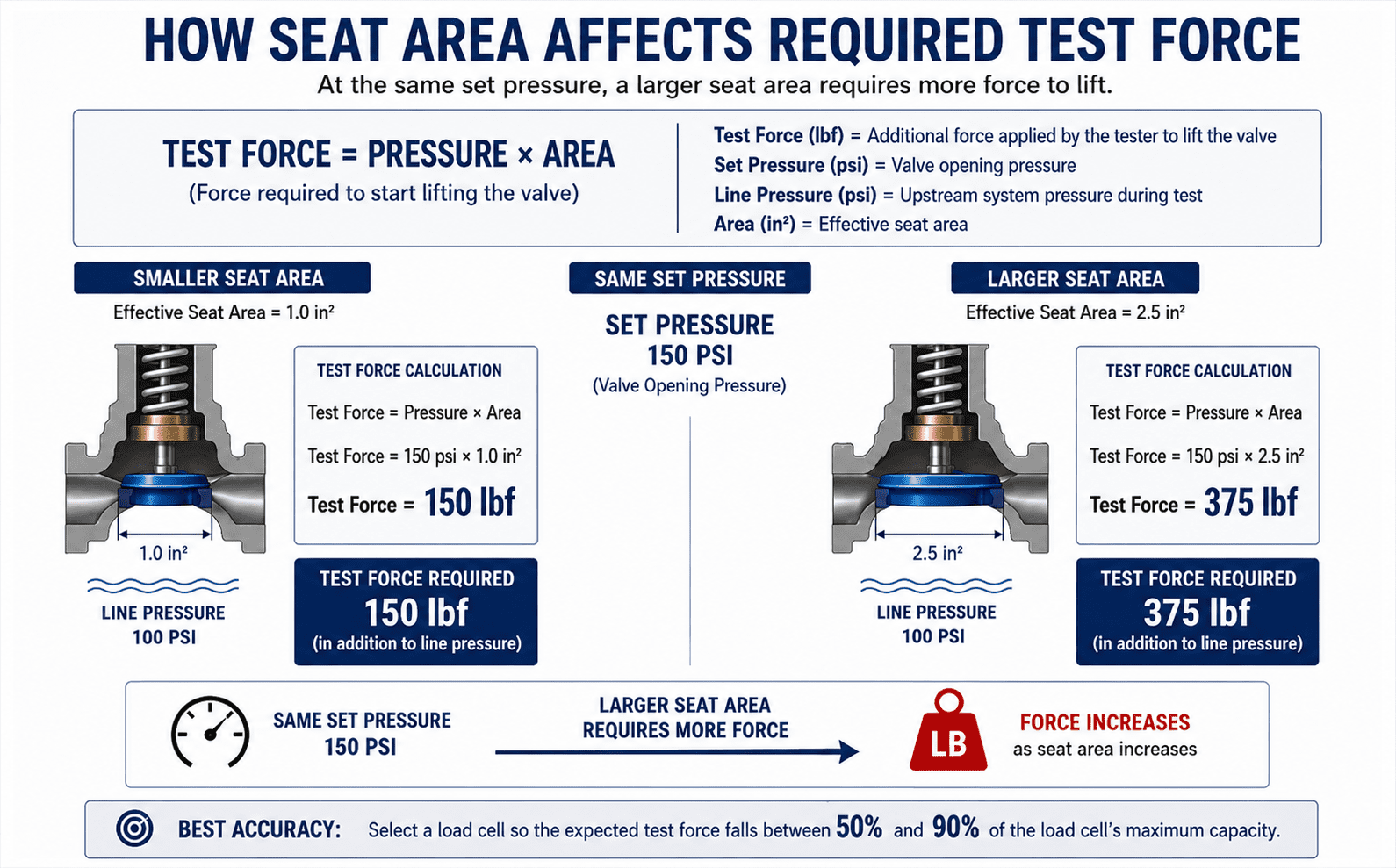
Field Insight: Why Seat Area Changes Everything
At the same set pressure, seat area—not valve size—drives required force.
What Does This Mean in the Field?
Two valves at the same pressure can require very different forces:
- Smaller seat → lower force required
- Larger seat → significantly higher force required
This is why:
- Valve size alone is not a reliable sizing method
- Larger valves often require much higher load cell capacity—even at the same pressure
Common Mistakes to Avoid:
Using valve size instead of force
→ Seat area determines force, not diameter alone
Oversizing the load cell
→ Reduces resolution and accuracy
Running near capacity
→ Increases risk and reduces measurement quality
Ignoring setup quality
→ Alignment and stability still matter
Practical Rule of Thumb
Estimate the lift force, then select a load cell so that force falls between 50% and 90% of its maximum capacity.
The Bottom Line
Load cell sizing is not complicated—but it is critical.
When done correctly:
- Test results are more accurate
- Lift detection is more precise
- Results are repeatable across technicians
- Confidence in field testing improves
And most importantly:
At the same set pressure, larger seat area means more required force—so your load cell must be sized accordingly.
FAQ: Load Cell Sizing for Valve Testing
What size load cell should I use for valve testing?
For valve testing, select a load cell where the expected lift force falls between 50% and 90% of its capacity.
How do you calculate lift force for a pressure relief valve?
To calculate lift force for a pressure relief valve, multiply set pressure by effective seat area.
Does valve size determine load cell size?
No, valve size does not determine load cell size. Seat area determines the required force.
What happens if a load cell is oversized?
Oversizing of load cells reduces measurement resolution and makes lift detection less accurate.
Improve Testing Accuracy with the Right System
Load cell sizing is only one part of achieving accurate, repeatable valve testing.
Force control, measurement stability, and system design all play a critical role in real-world performance.
AccuTEST systems are designed to deliver:
- Precise, controlled force application
- Consistent, repeatable lift detection
- Reliable results across technicians and test conditions
The result: more accurate testing, greater confidence in results, and better overall field performance.
Explore how AccuTEST systems improve pressure relief valve testing →


